



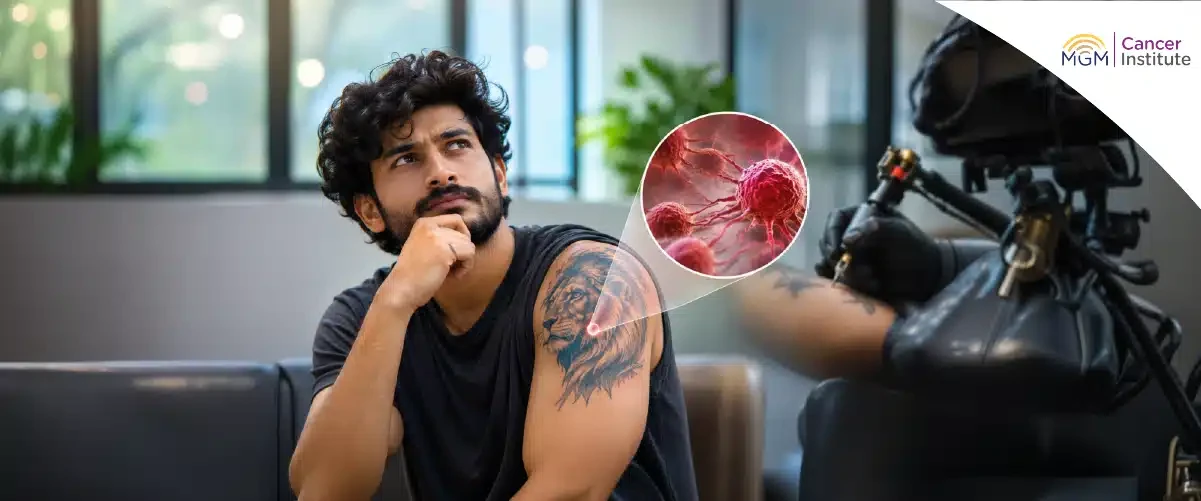
Can Tattoos Cause Cancer? Understanding the Possible Risks
Current scientific evidence has not established that tattoos directly cause cancer. However, some tattoo inks contain potentially harmful chemicals, and researchers are investigating their possible long-term health effects. While studies have explored links with skin cancer and lymphoma, the evidence remains inconclusive.
Understanding tattoo ink ingredients, possible health concerns and warning signs can help you make informed decisions about tattoo safety.
How Could Tattoo Ink Affect the Body?
When you get a tattoo a needle pushes ink into your skin. Unlike makeup or temporary body paint tattoo ink remains in the skin for a long time.
However not all of the tattoo ink stays in one spot.
Some of the tattoo ink particles can move through the body, Reach nearby lymph nodes. Lymph nodes are structures that help the body fight infections and support the immune system.
What Is in Tattoo Ink?
A tattoo ink is made of a mixture of chemicals and color pigments.
Some tattoo inks may contain the following substances:·
- metals: Tattoo inks may include traces of metals like nickel, chromium and other impurities.
- Chemical compounds: Tattoo inks can contain chemicals known as polycyclic aromatic hydrocarbons (PAHs).
- Colour pigments: Different pigments are used to create black red, blue, green and other shades.
Some of these substances are known to be harmful in forms of exposure.
However it is not yet clear whether the amounts and types found in inks can cause cancer when injected into the skin.
Is There a Link Between Tattoos and Cancer?
That’s where research comes in.
Studies have looked at the risk of people with tattoos developing certain cancers. In particular lymphoma is a type of cancer affecting the lymphatic system.
A few studies have reported an association between tattoos and lymphoma. However other studies have not found a link.
Research has also examined whether tattoos increase the risk of skin cancer. So Far there is no consistent evidence proving that tattoos cause skin cancer.
A possible association does not mean that tattoos directly cause cancer. More research is needed to understand the long‑term effects of ink.
How Can You Reduce the Risks Before Getting a Tattoo?
If you are planning to get a tattoo taking a precautions can help reduce the chances of complications.
1. Choose a good tattoo artist
2. Check the needles and equipment
3. Ask about the ink
4. Follow aftercare
5. Protect your skin from the sun. Use sun protection because skin with a tattoo can still get sun damage.
When Should You See a Doctor?
If you already have a tattoo you do not need to panic. Check for:
- A mole that changes in its size, shape or colour over time
- A strange growth, on the skin.
- Ongoing redness, swelling or itching around the tattoo.
- A wound that does not heal.
- A lump or swelling that does not disappear.
It is important not to ignore skin changes especially if they last or get worse.
How MGM Cancer Institute Can Help
Although there is no evidence that tattoos directly cause cancer learning about possible risk factors and noticing changes in skin remain important.
At MGM Cancer Institute, Chennai we encourage people to stay well‑informed about cancer and to seek advice when they notice unusual changes in skin or body.
If you notice a mole that changes a skin growth or a skin lesion that does not heal consult our specialists, for proper evaluation.
Early medical assessment can help detect concerning changes and ensure care.
Remember, not every skin change is cancer but every persistent or unusual change deserves attention.
Doctor details:
Dr. Syed Ismail Nawab John
Clinical Lead and Senior Consultant
Medical Oncology
Frequently Asked Questions
Skin cancer is a condition where abnormal cells grow in the skin. It can develop in different parts of the body, especially areas exposed to sunlight.
Some common signs include: A mole that changes in size, shape or colour, A new spot or growth on the skin, A sore that does not heal, A patch of skin that bleeds, itches or forms a crust.
Long-term exposure to ultraviolet (UV) rays from the sun or tanning beds is one of the main risk factors. Other factors include family history, fair skin and a history of sunburn.
Yes. Skin cancer can develop in areas that do not receive much sunlight, including the palms, soles of the feet and under the nails.
Many types of skin cancer can be treated successfully, especially when detected early. Treatment depends on the type, size and stage of the cancer.
Yes. Skin cancer can affect people of all skin tones. However, it may be detected later in people with darker skin because changes can be harder to notice.
Contact Us
Visiting Hours
OPEN 24 hours 7 days a week.
OPD Timings : Monday to Saturday
( 9:00 AM to 5:30 PM )
Appointments
Visit the hospital
MGM Cancer Institute
No 119 & 121, Nelson Manickam Road, Raajeswari Street, Rajaram Mehta Nagar,
Aminjikarai, Chennai – 600029



At MGM Cancer Institute, we believe in curing the fear of cancer first. We understand that battling cancer is not just a physical fight, but a mental and emotional one as well. Our dedicated team is committed to providing exceptional healthcare that improves your overall well-being and eases the anxiety that comes with cancer. With a 150-bed facility in the heart of your city, we are here to support you every step of the way.
© MGM Cancer Institute. All Rights Reserved. Last updated on 17-06-2026.
Part of MGM HEALTHCARE PRIVATE LIMITED